My feet were cold by the time I was halfway there, but I still enjoyed the ride!
After store hours, we had the third of four classes in this month's Park Tool School series (Oh, by the way, we have decided on one more series for this winter--a Sunday, Wednesday, Sunday Wednesday set starting on March 7th! More on that in a moment). As we were waiting for the last student to arrive (not remembering that he'd told me he wouldn't be there...), the topic of the letter that prompted my post "Riding at Night" was raised. I was asked about the exchanges, and what I had been doing since. It was cool that I had the bike in question there to do a brief "show and tell," as well.
I've been giving some thought to this whole thing. I do appreciate the perspective that Mr Tucker gave me. His statement boils down to that if I am between two motorists, one behind me traveling in the same direction and one coming the other way, the oncoming car's headlights make it hard for the motorist behind me to see me. As difficult as it is for me to believe that, I'll accept it at face value for the nonce, and play with the concept for a bit.
Having ridden that section of Westport Road a few dozen times, it's now almost indelibly burned into my brain's metaphorical DVD player. Riding it on the way home tonight didn't change my thoughts, but rather confirmed what I'd been thinking: If someone is likely to be blinded to my presence by oncoming traffic, they have already been dealing with my presence for at least a few seconds, and are well aware (or should be) of the fact of my being there. My bike is hard to ignore, especially at night.
In comments on my first post about this, Timothy mentioned that since I'm at about car headlight level, there may be something to the idea that car headlights overpower my blinkers and reflectors. One suggestion was to add lights higher up, say, on top of my helmet (or on a flag pole, by someone else). Given that motorists are (hopefully) spending at least part of their time looking at where their headlights are shining (road surface, for clues on where the road is, including painted lines on the road ahead of them), having most of my reflectors and lights in that area rather than where motorists are NOT looking (above their eye level) makes sense to me. In other words, I don't see a lot of value in putting lights where folks are not looking. That is not to say I'm against having a light on my helmet (indeed, I have a helmet with integrated lights). I would say that without a LOT of effort, it's hard to have a helmet light aimed in such a way as to help make me easier to see. Reflective stuff on the helmet makes a lot of sense to me, though, as it's easy to put there and low-maintenance (and low weight).
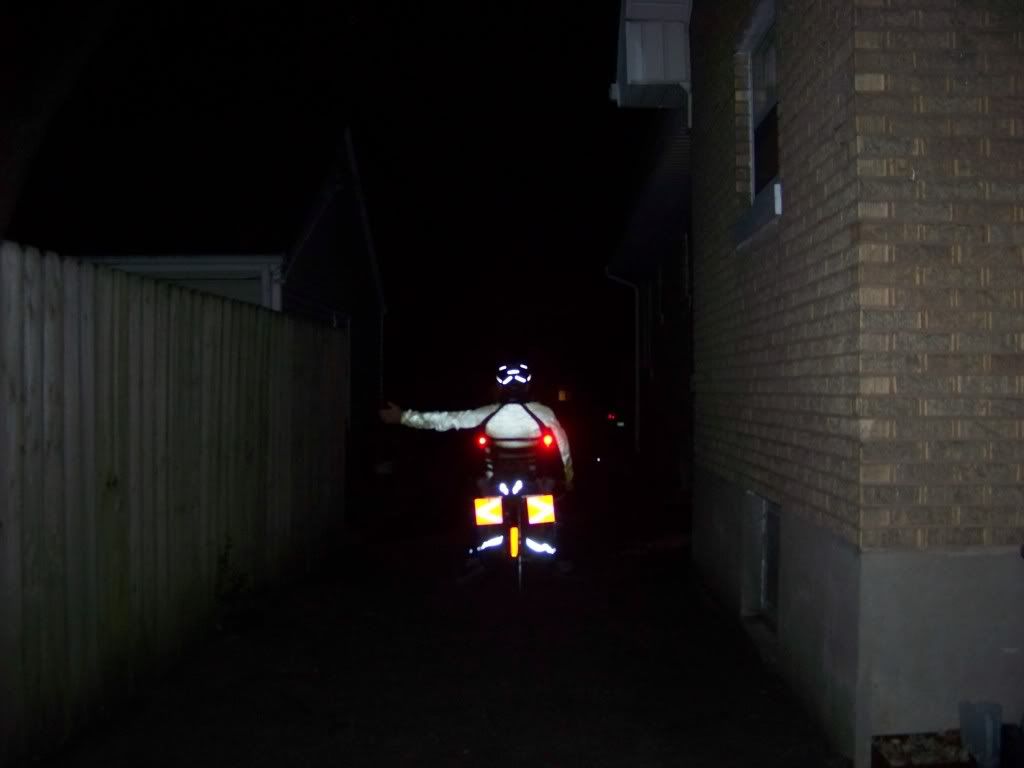
The pictures below were taken with a digital camera, using its built-in flash unit that I have previously described as being far weaker than electronic flash units built for amateur photography twenty-five years (or more) ago. I have a couple of Vivitar flashes programmed to work with my Canon film cameras (A-1, AT-1) of late 1970s or early 1980s manufacture that will reach into the drum kit that is upstage of the act currently entertaining the nightclub crowd from ten feet AWAY from the fifteen-foot deep stage. The current flash might reach the stage from the same chair. If there is nothing the camera's sensors figure is more important in the foreground. I've seen the side reflectors on my bikes with light from the back porch when I opened the back door to walk the dog, and they show up better than they do here.
Side view, obviously enough. One thing that comes to mind looking at this one is that it's time for a new front tire with the snazzy reflective sidewall. I can see it being difficult for folks who know nothing of recumbent bicycles to figure out what this apparition really is, aside from that it's clearly moving when they see it. Headlights were not turned on for this shot:

Front view, again obviously enough. This is the opposite side of what oncoming motorists would see (right instead of left), but it's clear enough (at least to me) that SOMETHING is moving here, or at least worthy of a second or two to see what the heck it is. This is pretty much what the clown SHOULD have seen, had he been looking, from Northumberland Drive as he pulled out almost into my right side a few weeks ago. I shouted him down, he stopped and lowered his window and listened as I told him he didn't stop for the stop sign, let alone look to see if there was anything coming before he blew the stop. He drove behind me until the road widened to four lanes! Anyway, here's the front view:

And, again, the rear view, this time with a left turn signal extended. The picture is a little blurry, despite the tripod use, possibly a function of the camera's difficulties in finding the bike before setting its auto focus. I may have moved at just the wrong moment, too. Anyway, this is the view Mr Tucker says would be washed out by the lights of an oncoming car, if the angles are just "wrong." Again, my real-world experience suggests that by the time a car is close enough to me that oncoming headlights would make me hard to see, the driver of said overtaking car has had ample time to realize I'm there. Indeed, he (or she) has been driving behind me for a few seconds at slower than the posted 25 MPH speed limit.
I didn't get to participate in the Bicycling for Louisville moving day extravaganza. Jenn did, however, and used the trailer to help haul stuff. Kirk Kandle has put a bunch of pictures up on his Flickr pages. Frequent readers will recognize my trailer (it's one of the smaller ones in use). Jenn is wearing the blue and yellow Kucharik jacket with the recumbent rider centered on her torso. Jenn told me she had a good time and got to meet and talk with some great folks. She also got to experience pulling a loaded bike trailer!


No comments:
Post a Comment